AI Cost Revolution: How Efficiency Breakthroughs Are Making AI Accessible
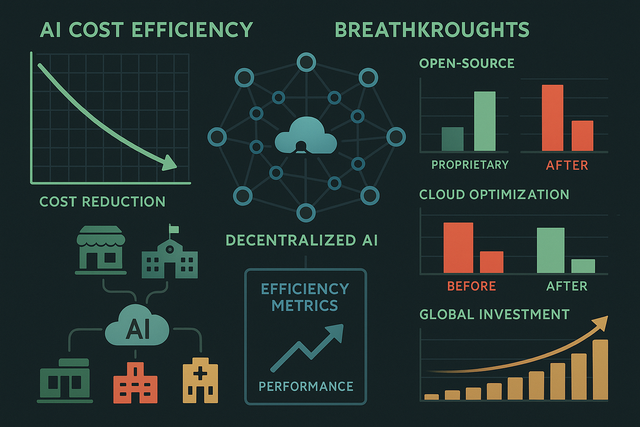
💰 2025 has witnessed unprecedented advances in AI cost efficiency, with dramatic reductions in both training and inference expenses that are fundamentally changing who can afford to develop and deploy advanced AI systems. These breakthroughs are democratizing AI access and enabling new categories of applications previously considered too expensive.
💸 The AI Cost Revolution
2025 has witnessed unprecedented advances in AI cost efficiency, with dramatic reductions in both training and inference expenses that are fundamentally changing who can afford to develop and deploy advanced AI systems. These breakthroughs are democratizing AI access and enabling new categories of applications previously considered too expensive
📊 Dramatic Cost Reductions: The Numbers
✅ Historic Cost Decline: GPT-3.5 inference costs dropped by over 280-fold from November 2022 to October 2024—a revolution in AI accessibility!
The Stanford AI Index 2025 reveals stunning cost improvements across the AI ecosystem:
🎯 Inference Costs
GPT-3.5 inference costs dropped by over 280-fold from November 2022 to October 2024
💻 Hardware Costs
Declining annually by 30%
⚡ Energy Efficiency
Improving by 40% annually
🔓 Open-Source Gap
Performance gap from closed models reduced from 8% to 1.7% in just one year
These improvements mean that what cost millions of dollars just a few years ago can now be achieved for thousands or even hundreds of dollars.
🌐 Decentralized Training: 10x Faster, 95% Cheaper
🚀 Breakthrough Achievement: Decentralized AI training strategies achieve 10x faster training speed and 95% cost reduction compared to traditional centralized methods.
One of the most significant breakthroughs in 2025 has been the development of decentralized AI training strategies. These approaches distribute training across multiple, less powerful devices rather than requiring massive, centralized supercomputing infrastructure
The results are remarkable:
⚡ 10x Speed Boost
Training speed increased by 10x compared to traditional methods
💰 95% Cost Savings
Costs reduced by 95%
🔓 Reduced Hardware Dependency
Reduced dependence on expensive hardware infrastructure
🎓 Improved Accessibility
Improved accessibility for smaller organizations and research institutions
These decentralized approaches leverage the combined computational power of thousands or even millions of consumer-grade devices, creating virtual supercomputers that rival traditional data centers in capability while costing a fraction of the price.
🔓 The Open Source Revolution
The performance gap between open-source and proprietary AI models has dramatically narrowed, making advanced AI capabilities accessible to anyone with basic computational resources:
🌟 OpenAI's Democratization Impact
ℹ️ Mass Accessibility: OpenAI's decision to release GPT-5 to all 700 million ChatGPT users represents a massive democratization of advanced AI capabilities.
OpenAI's decision to release GPT-5 to all 700 million ChatGPT users represents a massive democratization of advanced AI capabilities. The availability of GPT-5 mini for free users once usage limits are reached ensures that even budget-constrained users can access cutting-edge AI capabilities
🏆 Open Source Model Performance
Open-source models like GLM-4.5V and Qwen2.5-VL-72B are achieving near-frontier performance, with some benchmarks showing performance gaps of less than 2% compared to proprietary alternatives
⚙️ Efficient Model Architectures
Innovation in model architecture is driving significant efficiency improvements:
🔬 Distillation Techniques
Creating smaller, more efficient versions of large models while maintaining most performance
🎯 Mixture of Experts
MoE architectures activate only needed parts for specific tasks, dramatically reducing computational requirements
📉 Quantization & Pruning
Reducing precision and removing unnecessary parameters to create leaner, faster models
🔬 Distillation Techniques
Model distillation—creating smaller, more efficient versions of large models—has become increasingly sophisticated. These distilled models maintain most of the performance of their larger counterparts while requiring far fewer computational resources.
🎯 Mixture of Experts
Mixture of Experts (MoE) architectures allow models to activate only the parts needed for specific tasks, dramatically reducing computational requirements while maintaining performance.
📉 Quantization and Pruning
Advanced quantization techniques reduce the precision of model calculations without significant performance loss, while pruning removes unnecessary parameters to create leaner, faster models.
☁️ Cloud Infrastructure Optimization
Cloud providers are optimizing their infrastructure specifically for AI workloads:
💻 Specialized AI Chips
Cloud providers are deploying increasingly specialized AI chips designed for specific workloads, providing better price-performance ratios than general-purpose hardware.
⚡ Serverless AI
Serverless AI platforms allow users to pay only for actual compute usage, making AI experimentation and development more affordable for smaller organizations.
📱 Edge Computing
✅ Edge AI Advantage: Edge AI deployments reduce latency and bandwidth costs by processing data locally, making real-time AI applications more economically viable.
Edge AI deployments reduce latency and bandwidth costs by processing data locally, making real-time AI applications more economically viable.
🎯 Cost-Saving Strategies in Practice
🗺️ Model Routing
Intelligent routing systems automatically select the most appropriate model for each task, using smaller, faster models for simple queries and larger models only when necessary.
💾 Caching Strategies
Advanced caching techniques store results of previous calculations, avoiding redundant computations and reducing both costs and latency.
📈 Progressive Enhancement
Start with simple, low-cost solutions and add complexity only when needed, optimizing for the common case while maintaining capability for edge cases.
💼 The Economic Impact of AI Cost Reductions
These cost reductions are creating significant economic impact across multiple dimensions:
🏢 SME Access to AI
Small and medium enterprises that previously couldn't afford AI development can now implement sophisticated AI solutions, potentially transforming competitive dynamics in various industries.
🔬 Research Acceleration
Lower costs are enabling academic researchers and startups to conduct experiments that were previously prohibitively expensive, accelerating innovation across the AI field.
💡 New Business Models
The cost reductions are enabling entirely new business models, including AI-as-a-Service offerings and pay-per-use AI applications that weren't economically viable at previous cost levels.
🏥 Industry-Specific Cost Benefits
🏥 Healthcare
Healthcare organizations can now implement AI diagnostics and analysis tools at a fraction of previous costs, making advanced medical AI accessible to smaller hospitals and clinics.
🎓 Education
Educational institutions can deploy AI tutoring, assessment, and administrative tools without massive budget allocations, potentially transforming how education is delivered.
🛒 Retail & E-commerce
Small retailers can implement AI-powered recommendation systems, inventory management, and customer service tools previously available only to large corporations.
🌍 Global AI Investment Trends
📊 Investment Surge: The cost reductions are reflected in explosive global AI investment patterns:
The cost reductions are reflected in global AI investment patterns:
- US private AI investment reached $109.1 billion in 2024
- Generative AI global private investment reached $33.9 billion, an 18.7% increase from 2023
- Organizations using AI increased from 55% in 2023 to 78% in 2024
These investment levels indicate that the cost reductions are enabling broader AI adoption across organizations of all sizes.
⚠️ Challenges and Considerations
Despite the positive trends, several challenges remain:
⚖️ Quality vs. Cost Trade-offs
⚠️ Trade-off Alert: Lower-cost solutions may not always provide the same quality as premium alternatives, requiring careful evaluation of use-case requirements.
Lower-cost solutions may not always provide the same quality as premium alternatives, requiring careful evaluation of use-case requirements.
💸 Hidden Costs
Implementation, maintenance, and integration costs can offset savings from lower model costs, requiring comprehensive total cost of ownership analysis.
📈 Scalability Concerns
Some cost-saving approaches may not scale effectively, creating challenges for organizations that need to grow their AI capabilities over time.
🔮 Looking Ahead: The Future of AI Cost Efficiency
Several trends will continue driving AI cost reductions:
💻 Hardware Innovation
Continued advances in specialized AI chips, memory architectures, and interconnect technologies will further reduce computational costs.
⚙️ Algorithmic Improvements
Ongoing research in efficient architectures, training techniques, and optimization methods will continue to improve cost-effectiveness.
☁️ Infrastructure Optimization
Cloud providers will continue optimizing their infrastructure for AI workloads, providing better price-performance ratios.
🔓 Open Source Ecosystem
The open source AI ecosystem will continue maturing, providing high-quality alternatives to proprietary solutions.
📋 Strategic Recommendations
ℹ️ For Organizations: Comprehensive strategies for maximizing AI cost efficiency
For Organizations:
- 🧮 Evaluate Total Cost of Ownership: Consider all costs, including implementation, maintenance, and scaling
- 🚀 Start with Pilot Projects: Begin with smaller projects to understand cost structures before major investments
- 🔓 Consider Open Source Options: Evaluate open source alternatives that may provide similar capabilities at lower costs
- 📈 Plan for Scalability: Ensure chosen solutions can scale cost-effectively as needs grow
For Developers:
- ⚡ Focus on Efficiency: Prioritize efficient algorithms and architectures
- 📱 Consider Edge Deployment: Evaluate edge computing options for latency and cost benefits
- 💾 Implement Caching: Use intelligent caching to reduce redundant computations
- 📊 Monitor Costs: Implement comprehensive cost monitoring and optimization strategies
🎯 Conclusion: Democratizing AI Through Cost Innovation
✅ The New Reality: The cost revolution in AI is fundamentally changing the landscape of artificial intelligence development and deployment. What was once the domain of large corporations is now accessible to small businesses, individual developers, and resource-constrained organizations.
The cost revolution in AI is fundamentally changing the landscape of artificial intelligence development and deployment. What was once the domain of large corporations and well-funded research institutions is now accessible to small businesses, individual developers, and resource-constrained organizations.
These cost reductions are not just about making AI cheaper—they're about making AI possible. By dramatically reducing the barriers to entry, the AI cost revolution is unleashing a new wave of innovation and creativity that will shape the future of technology and society.
As costs continue to decline and efficiency improvements accelerate, we can expect to see AI applications that were previously unimaginable become routine, transforming industries and creating new opportunities for economic and social development.