AI-Powered Cyber Threats: The New Frontier of Digital Warfare
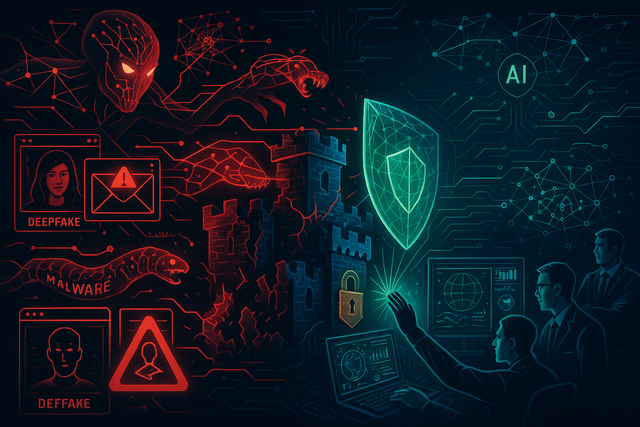
🚨 November 2025 marks a watershed moment in cybersecurity history: Google security researchers have identified what they claim is the first known case of hackers using AI-powered malware in real-world attacks. This discovery represents a fundamental shift in the cyber threat landscape, where artificial intelligence is no longer just a defensive tool but an offensive weapon, ushering in a new era of digital warfare.
🔒 The AI Cybersecurity Threat Landscape Transforms
November 2025 marks a watershed moment in cybersecurity history: Google security researchers have identified what they claim is the first known case of hackers using AI-powered malware in real-world attacks. This discovery represents a fundamental shift in the cyber threat landscape, where artificial intelligence is no longer just a defensive tool but an offensive weapon
🛡️ Google's Discovery: The First AI-Powered Malware
⚠️ Critical Discovery: Google's security team has identified the first AI-powered malware in the wild, marking a new era in cyber threats where intelligent adversaries can adapt in real-time.
The Google security team's findings reveal a new category of cyber threats that leverage AI capabilities for more sophisticated, adaptive, and evasive attacks. Unlike traditional malware that follows predetermined patterns, AI-powered malware can:
🎯 Real-Time Adaptation
Adapt its behavior in real-time to evade detection systems
🧠 Learning Capability
Learn from defensive countermeasures and adjust strategies
📧 Phishing at Scale
Generate convincing phishing content at massive scale
🔍 Auto Exploitation
Automate the discovery and exploitation of vulnerabilities
🌐 Coordinated Attacks
Coordinate complex attack campaigns across multiple systems
⚡ Dynamic Evasion
Modify tactics based on security responses
This represents a quantum leap in cyber threat sophistication, moving from static, rule-based attacks to dynamic, intelligent adversaries.
📈 The Evolution of AI in Cybercrime
The integration of AI into cybercriminal activities has been accelerating throughout 2025, driven by several factors:
💻 Democratization of AI Tools
The widespread availability of powerful AI models has lowered the barrier to entry for sophisticated cyber attacks. Criminal groups no longer need extensive technical expertise to deploy advanced threats.
💰 Economic Incentives
💵 Economic Reality: The potential returns from successful cyber attacks far exceed the costs of acquiring and deploying AI-powered tools, creating strong economic incentives for criminal adoption.
The potential returns from successful cyber attacks far exceed the costs of acquiring and deploying AI-powered tools, creating strong economic incentives for criminal adoption.
🔬 Technical Maturity
AI models have reached sufficient maturity to be practically useful for criminal applications, with capabilities that were science fiction just a few years ago now becoming reality.
⚠️ Key Threat Categories Emerging in 2025
📧 AI-Enhanced Phishing and Social Engineering
AI systems can now generate highly personalized and convincing phishing content by analyzing social media profiles, public records, and communication patterns. The 2025 Global Threat Report from CrowdStrike highlights how AI is enabling more targeted and successful social engineering attacks
🎯 Personalized Attack Vectors
AI analyzes social media, public records, and communication patterns to create hyper-targeted phishing campaigns that are nearly indistinguishable from legitimate communications.
🤖 Autonomous Exploitation Tools
AI-powered tools can automatically discover vulnerabilities, generate exploits, and launch attacks with minimal human intervention. This automation enables attackers to scale their operations dramatically.
🎭 Deepfake-Enabled Attacks
⚠️ Deepfake Danger: Sophisticated deepfake technology is being used to impersonate executives, bypass voice authentication systems, and conduct fraud at scale. Traditional verification methods are now insufficient.
Sophisticated deepfake technology is being used to impersonate executives, bypass voice authentication systems, and conduct fraud at scale. The quality of these deepfakes has reached a point where traditional verification methods are insufficient.
🔐 Adaptive Ransomware
AI-enhanced ransomware can dynamically adapt its encryption methods, evade security controls, and even negotiate ransom payments using natural language processing.
📊 The Scale of the Threat: Industry Reports
🦅 CrowdStrike's 2025 Global Threat Report
The report identifies a significant increase in malware-free threats, where attackers use legitimate tools and AI to achieve their objectives without deploying traditional malware
📈 Malware-Free Threats Rising
CrowdStrike reports significant increase in attacks using legitimate tools and AI, making detection exponentially harder for traditional security systems.
🔍 SentinelOne's AI Security Risk Assessment
ℹ️ Key Findings: SentinelOne has identified 14 distinct AI security risks that organizations must address, including data poisoning, model inversion, and adversarial examples
SentinelOne has identified 14 distinct AI security risks that organizations must address, including data poisoning, model inversion, and adversarial examples
🛡️ IBM X-Force Threat Intelligence
IBM's 2025 report emphasizes the transformation of cyber defense into cyber resilience, recognizing that traditional perimeter-based security is insufficient against AI-enhanced threats
⚙️ How AI-Powered Attacks Work
🔍 Intelligence Gathering
AI systems rapidly analyze vast amounts of publicly available information to build detailed target profiles and identify vulnerabilities.
🎭 Adaptive Evasion
Real-time behavior modification to avoid detection by security systems, learning from defensive responses.
🌐 Multi-Vector Attacks
Coordinated simultaneous attacks across multiple vectors, overwhelming traditional defense systems.
🗺️ Post-Compromise Intelligence
Automatic network mapping, valuable data identification, and optimal exfiltration strategies.
🔍 Intelligence Gathering
AI systems can rapidly analyze vast amounts of publicly available information to build detailed profiles of targets, identifying potential vulnerabilities and high-value objectives.
🎭 Adaptive Evasion
Unlike traditional malware, AI-powered attacks can modify their behavior in real-time to avoid detection by security systems, learning from defensive responses and adjusting tactics accordingly.
🌐 Coordinated Multi-Vector Attacks
AI can coordinate simultaneous attacks across multiple vectors, overwhelming traditional defense systems and increasing the likelihood of successful breaches.
🗺️ Post-Compromise Intelligence
Once inside a system, AI-powered malware can automatically map network topology, identify valuable data, and determine optimal exfiltration strategies.
🛡️ Defensive Strategies for AI-Powered Threats
⚔️ AI vs. AI: The New Cybersecurity Paradigm
✅ Defense Evolution: Organizations are increasingly turning to AI-powered defensive systems to counter AI-powered threats, creating an AI vs AI security paradigm.
Organizations are increasingly turning to AI-powered defensive systems to counter AI-powered threats. This approach involves using machine learning to:
📊 Anomaly Detection
Detect anomalous behavior patterns in network traffic
🔍 Content Analysis
Identify AI-generated content that doesn't match known signatures
🎯 Adaptive Defense
Adapt defensive strategies based on observed attack patterns
⚡ Auto Response
Automate incident response and threat mitigation
🔒 Zero Trust Architecture
🎯 Zero Trust Approach: Zero trust security models assume that threats can originate from any source and require continuous verification of all users, devices, and applications—critical against AI threats that can mimic legitimate users.
Zero trust security models assume that threats can originate from any source and require continuous verification of all users, devices, and applications. This approach is particularly important against AI-powered threats that can mimic legitimate users.
🎓 Enhanced Training and Awareness
Human factors remain critical in cybersecurity. Organizations are investing heavily in training programs that help employees recognize AI-generated deepfakes and sophisticated social engineering attacks.
🏛️ Government Response and Regulatory Action
Governments worldwide are recognizing the severity of AI-powered cyber threats and taking action:
🇺🇸 CISA Guidelines
The Cybersecurity and Infrastructure Security Agency (CISA) has issued updated guidelines for protecting against AI-powered threats, including recommendations for AI security frameworks
📋 CISA Framework Release
US CISA issues comprehensive guidelines for protecting against AI-powered threats, including AI security frameworks and incident response protocols.
🌍 International Cooperation
International organizations are working to establish frameworks for cooperation on AI cybersecurity threats, recognizing that these challenges transcend national boundaries.
🤝 Public-Private Partnerships
Governments are increasingly partnering with private sector cybersecurity companies to develop and deploy AI-powered defensive capabilities.
🏢 Industry-Specific Vulnerabilities
Different sectors face unique challenges from AI-powered cyber threats:
💰 Financial Services
Targets for AI-powered fraud, market manipulation, and automated trading attacks affecting global financial stability.
🏥 Healthcare
Threats from AI-powered attacks on medical devices, patient data theft, and disruption of critical medical services.
⚡ Critical Infrastructure
Power grids, transportation systems vulnerable to AI-powered attacks with catastrophic real-world consequences.
🏛️ Government & Defense
Prime targets for AI-powered espionage and cyber warfare operations.
💵 Economic Impact of AI-Powered Cyber Threats
⚠️ Economic Consequences: The economic implications of AI-powered cyber threats are staggering, affecting insurance costs, consumer confidence, regulatory frameworks, and requiring massive investments in defensive capabilities.
The economic implications of AI-powered cyber threats are staggering:
- Increased costs for cybersecurity measures and insurance
- Potential for larger-scale financial fraud and market manipulation
- Damage to consumer confidence in digital services
- Need for new regulatory frameworks and compliance requirements
- Investment in AI-powered defensive capabilities
🔮 The Future of AI-Powered Cyber Threats
As AI technology continues to advance, we can expect:
📈 Increased Sophistication
AI-powered attacks will become more sophisticated, making them harder to detect and defend against using traditional methods.
🤖 Automation of the Entire Attack Chain
Future AI-powered threats may automate the entire attack lifecycle, from initial reconnaissance to final exfiltration, requiring minimal human oversight.
🌐 Cross-Platform Integration
AI-powered attacks may coordinate across multiple platforms and attack vectors simultaneously, overwhelming traditional defense systems.
🎯 Personalized Social Engineering
AI will enable highly personalized social engineering attacks that target individuals based on their specific digital footprints and behavioral patterns.
✅ Preparing for the AI-Powered Threat Landscape
✅ Action Plan: Organizations must take immediate action to prepare for AI-powered cyber threats through five critical strategies.
🛡️ Invest in AI-Powered Defenses
Deploy AI-based security tools that can detect and respond to intelligent threats
🔒 Implement Zero Trust Architecture
Adopt comprehensive security models that don't assume internal network trust
🎓 Enhance Employee Training
Provide comprehensive training on recognizing AI-generated threats
📋 Develop Incident Response Plans
Create specific protocols for AI-powered attack scenarios
📡 Engage with Threat Intelligence
Stay informed about emerging AI-powered threat vectors and defensive strategies
🎯 Conclusion: The New Reality of Cybersecurity
The emergence of AI-powered malware represents a fundamental shift in the cybersecurity landscape. Traditional reactive security measures are insufficient against adversaries that can learn, adapt, and evolve in real-time.
Organizations, governments, and individuals must recognize that the cybersecurity battlefield has changed irrevocably. The integration of AI into both offensive and defensive capabilities will define the next phase of cyber conflict, requiring new strategies, technologies, and collaborative approaches to ensure digital security in an age of intelligent threats.
🚨 Critical Takeaway: The AI revolution in cybersecurity is not coming—it has arrived, and our response will determine the security of our digital future.
The discoveries of 2025 serve as a warning: the AI revolution in cybersecurity is not coming—it has arrived, and our response will determine the security of our digital future.