AI for Social Good: How Artificial Intelligence is Addressing Global Challenges
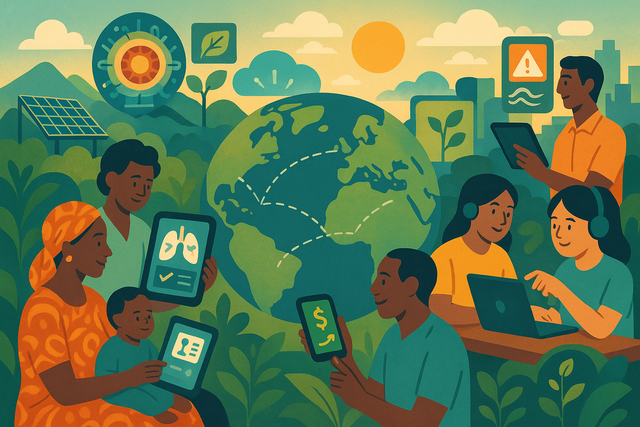
🌍 2025 has witnessed remarkable applications of artificial intelligence addressing humanity's greatest challenges—from climate change to healthcare equity, educational access to disaster response. AI is proving to be a transformative force for social good when ethically deployed in partnership with the communities it serves.
🌱 Climate Change & Environmental Protection
⚡ Fusion Energy
Google DeepMind + CFS partnership accelerating clean unlimited energy through AI-optimized fusion reactions, offering carbon-free power with potential to replace fossil fuels globally.
🌍 Earth AI Monitoring
Google Earth AI tracking deforestation, ocean health, climate patterns, and biodiversity with real-time environmental monitoring for conservation worldwide.
🏭 Carbon Capture
AI designing new materials for carbon capture/storage, optimizing renewable energy grids, and tracking industrial emissions with unprecedented accuracy.
🏥 Healthcare Access & Equity
Medical Device Revolution: AI-enabled medical devices increased from 6 (2015) to 223 (2023), bringing specialist-level care to rural areas, identifying health risks before symptoms, and optimizing limited resources.
🔬 Cancer Research
Google's Cell2Sentence and DeepSomatic democratizing advanced cancer research for developing countries, accelerating discovery and enabling personalized genetic treatments.
🌐 Global Health
AI predicting disease outbreaks, optimizing malaria elimination, improving TB management, and supporting maternal health worldwide.
📚 Educational Equity & Access
💻 K-12 Computer Science
Two-thirds of countries now offering K-12 CS education, preparing students with digital literacy, critical thinking, and human-AI collaboration skills for global competitiveness.
🎓 Google Skills Platform
Nearly 3,000 free courses/labs removing financial barriers, providing expert-led AI training with hands-on experience accessible to learners worldwide.
🗣️ Language Preservation
AI documenting endangered languages, preserving cultural artifacts, breaking translation barriers, and creating locally relevant educational content.
💼 Economic Development & Poverty Reduction
💰 Financial Inclusion
AI-powered mobile banking, credit assessment for unbankable populations, financial literacy programs, and microfinance optimization expanding access globally.
🌾 Agricultural Innovation
AI monitoring crops, enabling precision farming, connecting farmers to markets, and helping adapt to climate change in developing countries.
🏪 Small Business Support
AI providing business analytics, marketing optimization, supply chain management, and financial planning to help small businesses compete globally.
⚖️ Social Justice & Human Rights
Bias Detection: AI identifying and reducing racial bias in criminal justice sentencing, preventing discriminatory hiring, addressing housing discrimination, and ensuring equitable educational opportunities.
🛡️ Human Rights Monitoring
AI analyzing satellite imagery to document abuses, optimizing refugee services, and protecting civil rights in real-time.
♿ Accessibility
AI providing visual content descriptions, real-time sign language translation, controlling assistive devices, and supporting neurodivergent individuals.
🚨 Disaster Response & Emergency Management
⚠️ Early Warning Systems
AI predicting earthquakes from seismic data, improving hurricane tracking accuracy, forecasting floods, and detecting wildfires in real-time.
🚑 Response Optimization
AI optimizing emergency responder deployment, designing evacuation routes, facilitating crisis communication, and rapidly assessing disaster damage.
⚠️ Challenges & Ethical Considerations
Digital Divide: Infrastructure gaps, economic barriers, education gaps, and language limitations mean AI benefits may not reach all populations equally. Ensuring equity requires addressing access disparities.
🔒 Privacy Protection
Ensuring meaningful consent, data minimization, anonymization, and security to protect individuals while deploying AI for social good.
🌏 Cultural Sensitivity
Understanding local context, involving communities in design, and avoiding cultural bias in AI applications across diverse populations.
📊 Impact Measurement
Defining clear metrics, continuous monitoring, community feedback, and long-term evaluation to ensure AI initiatives are effective.
🔮 Future Directions
🧠 Emerging Applications
Mental health support, senior care, equitable urban planning, and enhanced democratic participation expanding AI's social impact.
🤝 Global Collaboration
Knowledge sharing, resource pooling, ethical standard setting, and capacity building in developing countries essential for worldwide AI progress.
AI as a Catalyst for Global Progress: AI demonstrates tremendous potential to address climate change, healthcare access, educational equity, and disaster response. However, realizing this potential requires careful attention to equity, privacy, and cultural sensitivity. By maintaining focus on human welfare and developing AI in partnership with communities, we can ensure these technologies contribute to a more just, sustainable, and prosperous world for all of humanity.