Multimodal AI Breakthrough: Vision-Language Models Reshape Computer Vision
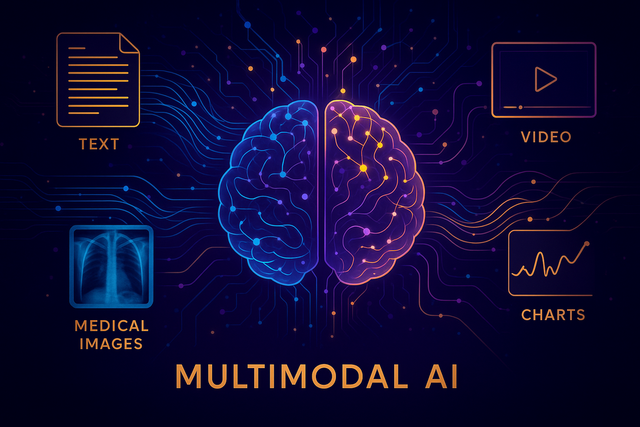
2025 has witnessed remarkable advances in multimodal artificial intelligence, with vision-language models achieving near-human performance in understanding and generating content across multiple modalities. These systems represent a fundamental shift from single-mode AI to comprehensive, context-aware intelligence
🎨 The Multimodal AI Revolution
Multimodal AI systems represent a fundamental shift from single-mode AI to comprehensive, context-aware intelligence that mirrors human cognitive processes.
🧠 Understanding Multimodal AI
Multimodal AI systems can process and understand information from multiple sources simultaneously—including text, images, audio, and video. Unlike traditional AI models that excel in a single domain, these systems can:
📝➡️🖼️ Text to Image
Generate text descriptions of complex images with contextual understanding
🖼️➡️📝 Image to Text
Create detailed images from text descriptions with artistic interpretation
🎬 Video Analysis
Analyze video content and extract meaningful temporal information
🔄 Cross-Modal Context
Understand context across different modalities seamlessly
💡 Coherent Responses
Generate coherent cross-modal responses integrating all inputs
This capability mirrors human cognitive processes, where we naturally integrate information from multiple senses to form comprehensive understanding88 .
🏆 Leading Models in 2025
The landscape of multimodal AI has been dominated by several breakthrough models:
🌟 GLM-4.5V: The Open-Source Leader
Developed by Z.ai, GLM-4.5V features 106 billion parameters (with 12 billion active), making it one of the most capable open-source vision-language models available
The model demonstrates exceptional performance in visual reasoning, object detection, and multimodal understanding tasks.
☁️ Qwen2.5-VL-72B Instruct
Alibaba's Qwen2.5-VL-72B Instruct has emerged as a leading commercial vision-language model, offering robust performance across various benchmarks while maintaining accessibility for enterprise applications
🔷 Google's Gemini 1.5 Pro
Google's latest iteration of Gemini demonstrates advanced multimodal capabilities, with the ability to process long-form video content and provide detailed analysis. The model is being integrated into Google Maps and other consumer applications
💡 Key Innovation: Gemini 1.5 Pro can process up to 1 million tokens, enabling analysis of hour-long videos or extensive document collections in a single request.
🤖 OpenAI's GPT-4o Vision
OpenAI's GPT-4o Vision capabilities have been enhanced significantly with GPT-5, offering superior multimodal understanding. The model excels at:
- 📊 Interpreting complex charts, graphs, and presentations
- 🗺️ Understanding spatial relationships in images
- 🔬 Analyzing scientific diagrams and technical drawings
- 📸 Generating detailed, accurate descriptions of visual content
- ❓ Answering questions about images with high precision
This advancement represents a significant step toward truly comprehensive AI systems that can understand and communicate across all human communication modalities11 .
🌍 Real-World Applications
The practical applications of multimodal AI are expanding rapidly across industries:
🏥 Healthcare and Medical Imaging
Multimodal AI is revolutionizing medical diagnostics by combining patient records, medical images, and clinical notes to provide comprehensive diagnostic assistance. These systems can:
🔍 Anomaly Detection
Identify anomalies in X-rays, MRIs, and CT scans with high accuracy
🔗 Data Correlation
Correlate visual findings with patient history and lab results
💊 Differential Diagnosis
Suggest differential diagnoses based on combined inputs
📄 Report Generation
Generate detailed radiology reports automatically
The FDA approved 223 AI-enabled medical devices in 2023, compared to just 6 in 2015—a 37-fold increase demonstrating the maturation of multimodal AI in healthcare
🎓 Education and Training
Educational applications of multimodal AI include:
- Automated grading of visual assignments and presentations
- Content creation combining text, images, and videos
- Personalized learning based on multiple input types
- Accessibility tools for students with different learning styles
🎬 Content Creation and Media
Creative industries are leveraging multimodal AI for:
- 🖼️ Generating images from text descriptions
- 🎥 Creating videos with synchronized audio and visual elements
- 🛡️ Automated content moderation across multiple modalities
- 🌐 Real-time translation of multimedia content
⚙️ Technical Breakthroughs
Several technical innovations have enabled the current generation of multimodal AI:
🏗️ Unified Architecture
Modern multimodal models employ unified architectures that can process different input types through shared representation spaces, enabling more coherent cross-modal understanding89 .
🎯 Advanced Training Techniques
New training methodologies include:
1️⃣ Contrastive Learning
Learning across modalities by contrasting similar and dissimilar pairs
2️⃣ Cross-Modal Attention
Attention mechanisms that relate elements across different modalities
3️⃣ End-to-End Training
Training on large-scale multimodal datasets without separate preprocessing
4️⃣ Progressive Training
Gradually building from single to multi-modal capabilities
🛡️ Safety and Alignment
Ensuring multimodal AI systems behave safely across different modalities presents unique challenges. Google introduced the first open multimodal safety model in early 2025, providing guidelines for responsible multimodal AI development
📊 Performance Benchmarks and Evaluation
The multimodal AI field has established several key benchmarks:
📚 MMMU
Massive Multi-discipline Multimodal Understanding: Tests models across multiple academic disciplines
❓ VQA
Visual Question Answering: Evaluates image understanding and Q&A capabilities
🎨 Text-to-Image
Assesses quality and relevance of AI-generated images
🎬 Video Understanding
Tests temporal reasoning and action recognition in video content
Performance improvements have been remarkable, with leading models achieving significant gains on these benchmarks throughout 2025
⚠️ Challenges and Limitations
Despite rapid progress, multimodal AI faces several significant challenges:
💻 Computational Requirements
Processing multiple modalities simultaneously requires substantial computational resources, limiting accessibility for smaller organizations and individual developers86 .
📊 Data Quality and Bias
Multimodal models require high-quality, diverse datasets across all modalities. Bias in training data can lead to unfair or inaccurate outputs, particularly problematic when dealing with sensitive content like medical images or personal photos
🔍 Interpretability
Understanding how multimodal models make decisions across different input types remains challenging, making it difficult to debug errors or ensure consistent behavior
💰 Industry Impact and Economic Implications
The Stanford AI Index 2025 reports that AI is becoming more efficient and accessible, driven partly by advances in multimodal capabilities. The 280-fold reduction in inference costs for systems like GPT-3.5 has made multimodal AI more economically viable for widespread adoption
🔮 Future Directions
The next phase of multimodal AI development will likely focus on:
⚡ Real-Time Processing
Real-time multimodal processing for interactive applications and live streaming
🎵 Audio-Video Integration
Better integration of audio, video, and sensor data for immersive experiences
🎯 Few-Shot Learning
Improved few-shot learning across modalities for rapid adaptation
🛡️ Enhanced Safety
Enhanced safety measures for sensitive applications and regulated industries
📱 Edge Deployment
More efficient architectures for edge deployment on mobile devices
🌟 The Path Forward
Multimodal AI represents a crucial step toward artificial general intelligence (AGI) by modeling the way humans naturally process and integrate information from multiple sources.
As these systems become more capable and accessible, they will likely transform how we interact with technology and process information across all aspects of work and life.
The convergence of advances in vision, language, and reasoning capabilities positions multimodal AI as a cornerstone technology for the next generation of intelligent systems.