AI Ethics and Governance: Building Responsible AI Systems for the Future
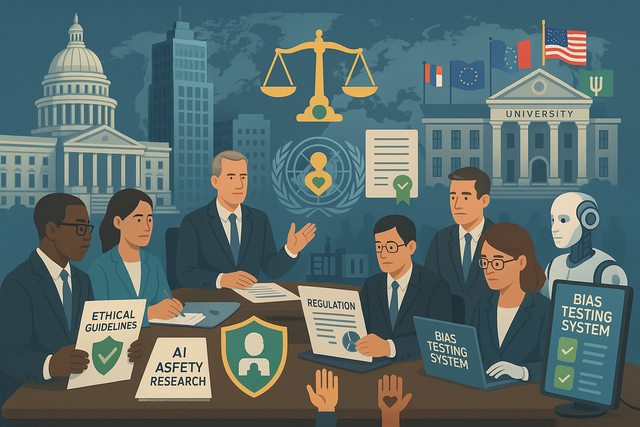
⚖️ 2025 has marked a crucial turning point: as AI systems become more powerful and widespread, establishing comprehensive ethical frameworks and governance structures is more urgent than ever. The combination of advanced AI capabilities, widespread deployment, and growing recognition of potential risks demands responsible AI systems.
🎯 Key Ethical Challenges
⚖️ Bias & Fairness
Training data bias, underrepresentation issues, algorithmic discrimination in hiring/lending/justice, intersectional biases affecting multiple demographics.
🔒 Privacy & Surveillance
Extensive data collection, unprecedented surveillance capabilities, inference attacks revealing private information from innocuous data.
🔍 Transparency
Black box problem making decisions opaque, inadequate explanation methods, accountability challenges for AI system decisions.
👤 Human Agency
Decision automation replacing humans, manipulation potential, skill atrophy from over-reliance on AI systems.
🏛️ Governance Frameworks
Global Regulatory Progress: US with 59 new regulations (2024), EU AI Act comprehensive framework, China national strategy with data sovereignty focus, international cooperation growing on AI governance standards.
🇺🇸 United States
America's AI Action Plan (3 pillars), increased federal regulation, AI Safety Institutes establishment.
🇪🇺 European Union
AI Act framework, human-centric AI emphasis, cross-border cooperation initiatives.
🏢 Industry Self-Regulation
AI ethics boards, responsible AI principles, stakeholder engagement, transparency reports.
🛡️ AI Safety & Alignment
GPT-5 Safety Advances: Deception reduced from 4.8% to 2.1%, 'safe completions' training, enhanced biological/chemical protocols, 5,000 hours comprehensive red teaming testing.
🔬 Technical Research
Alignment techniques for intended goals, robustness across scenarios, interpretability methods for behavior understanding.
🏗️ Constitutional AI
Anthropic's ethical principles training, predictable behavior focus, enterprise safety emphasis.
🗳️ Democracy & Democratic Values
📊 Electoral Impact
AI-generated misinformation, precise microtargeting, bot network manipulation.
🏛️ Governance
Enhanced/limited public participation, AI in government decisions, democratic accountability needs.
💼 Economic Justice
Job displacement concerns, changing skill requirements, wage effects, economic concentration risks.
🌍 Global Cooperation
International Efforts: AI arms race competition, standards development divergence, talent competition, UN/OECD frameworks, technical standards creation, ethical guidelines consensus building.
👥 Stakeholder Engagement
🤝 Multi-Stakeholder
Civil society participation, academic research contributions, industry implementation, government regulation.
📢 Public Engagement
Consultation in policy, education about implications, democratic participation ensuring.
✅ Best Practices
⚙️ Technical Practices
Development team diversity, systematic bias testing, transparency maximization, meaningful human oversight.
🏢 Organizational
Ethics training for all staff, impact assessments pre-deployment, stakeholder engagement, continuous monitoring.
🔮 Future Directions
AGI governance preparation, AI rights considerations, adaptive regulation, AI-assisted governance, experimental sandboxes.
Building an AI Future for All: Robust AI ethics and governance represents one of our time's most critical challenges. Progress in 2025—regulatory frameworks, industry self-regulation, safety research—provides a foundation. Effective governance requires ongoing collaboration between governments, industry, academia, civil society, and public, balancing innovation with safety, efficiency with fairness, capability with human values to create AI that enhances human capabilities, protects rights, promotes flourishing, and addresses global challenges.