AI Safety and Regulation: Governments Worldwide Take Action in 2025
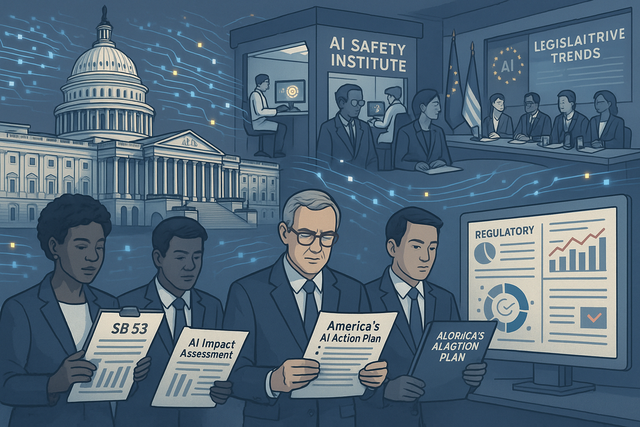
2025 has witnessed unprecedented governmental action on artificial intelligence regulation and safety measures. From the United States' comprehensive AI Action Plan to California's pioneering transparency legislation, governments worldwide are establishing frameworks to govern AI development, deployment, and use
⚖️ The Global AI Regulatory Landscape
Governments worldwide are establishing comprehensive frameworks to govern AI development, balancing innovation with safety, fairness, and accountability.
🇺🇸 America's AI Action Plan: A Federal Approach
In July 2025, the White House released America's AI Action Plan, establishing a federal framework for AI governance
The plan centers on three key policy pillars:
1️⃣ Accelerating Innovation
Supporting AI research and development while ensuring competitive advantage in global markets
2️⃣ Building AI Infrastructure
Developing the computational and data infrastructure needed for AI advancement
3️⃣ Leading International Diplomacy
Establishing US leadership in global AI governance and security frameworks
The plan explicitly addresses the tension between innovation and regulation, emphasizing that federal funding should not be directed toward states with burdensome AI regulations that hinder progress68 .
🌟 State-Level Innovation: California's SB 53
California Governor Gavin Newsom signed Senate Bill 53 (SB 53), known as the Transparency in Frontier Artificial Intelligence Act, on September 29, 2025
Key provisions of SB 53 include:
📋 Mandatory Disclosure
Disclosure of AI system capabilities and limitations
📊 Impact Assessments
Requirements before deployment in critical systems
🔬 Safety Institutes
Establishment for testing and evaluation
⚠️ Penalties
For non-compliance with transparency requirements
💡 Legal experts suggest this legislation may serve as a model for other states and potentially federal action, setting nationwide standards70 .
📈 The Regulatory Explosion: By the Numbers
The Stanford AI Index 2025 reveals the scale of governmental action on AI regulation:
- US federal agencies increased AI-related regulations by 59 actions in 2024
- Global legislative mentions of AI increased by 21.3% since 2023
- Since 2016, global legislative mentions of AI have increased ninefold
- Two-thirds of countries now offer or plan K-12 computer science education
This represents a fundamental shift in how governments approach AI governance, moving from reactive policy-making to proactive regulatory frameworks72 .
🌍 International Cooperation and Competition
Countries worldwide are establishing AI safety institutes and governance frameworks, creating a new landscape of international AI cooperation and competition:
🇨🇳 China's Semiconductor Initiative
China has committed $47.5 billion to a semiconductor fund, recognizing AI hardware as crucial for technological sovereignty and competitive advantage
🇪🇺 European Approach
The European Union continues to develop comprehensive AI regulations focusing on high-risk applications and fundamental rights protection, balancing innovation with privacy and safety concerns.
🇬🇧 UK Innovation Strategy
The United Kingdom has invested £4.5 billion in private AI investment in 2024, supporting a regulatory approach that emphasizes innovation while ensuring safety
🗺️ Legislative Trends Across US States
State lawmakers have accelerated their focus on AI regulation in 2025, proposing diverse regulatory models:
🛡️ Safety-First Approaches
Testing, monitoring, and fail-safes in critical infrastructure AI systems
🚀 Innovation-Friendly Frameworks
Business-friendly environments with light-touch oversight
🏥 Industry-Specific Regulations
Sector-specific rules for healthcare, finance, transportation
🔬 The Role of AI Safety Institutes
AI safety institutes are emerging as crucial components of national AI strategies. These organizations serve multiple functions:
📋 Standards Development
Developing standards for AI safety testing and evaluation protocols
🔬 Research Initiatives
Conducting research on AI risks and mitigation strategies
📖 Guidance Provision
Providing guidance to developers and deployers of AI systems
🤝 International Cooperation
Facilitating international cooperation on AI safety standards
The first AI safety institutes emerged in 2024, with rapid expansion in 2025 as governments recognize the need for specialized expertise in AI safety evaluation72 .
⚠️ Key Regulatory Challenges
Government regulators face several complex challenges in governing AI:
💻 Technical Complexity
AI systems are rapidly evolving, making it difficult for regulators to establish stable standards and requirements. The pace of technological change often outstrips the regulatory response time.
🌐 Global Coordination
AI development is inherently global, requiring international cooperation on standards and regulations. However, different countries have varying approaches to AI governance, creating potential conflicts.
⚖️ Balancing Innovation and Safety
Regulators must balance encouraging innovation with ensuring safety. Over-regulation could stifle beneficial AI development, while under-regulation could lead to harmful outcomes.
🏢 Industry Response to Regulation
The technology industry has generally responded positively to clear, predictable regulatory frameworks. Key industry positions include:
- 🌍 International Standards: Support for harmonization across jurisdictions
- 🎯 Risk-Based Approaches: Emphasis on proportional regulation
- 🧪 Regulatory Sandboxes: Call for testing environments
- 🤝 Self-Regulation: Advocacy for industry-led governance in certain areas
Companies are increasingly establishing AI ethics teams and governance structures to comply with emerging regulations while maintaining competitive advantage.
💰 The Economic Impact of AI Regulation
AI regulation has significant economic implications:
💵 Compliance Costs
Investment in compliance systems, legal expertise, and safety testing
🚀 Innovation Incentives
Market opportunities for companies leading in AI safety
🌐 Global Competition
Countries competing to attract AI investment and talent
🔮 Looking Ahead: The Future of AI Regulation
Several trends will likely shape AI regulation in the coming years:
🔄 Convergence of Standards
International efforts to harmonize AI standards will likely accelerate, with organizations like the OECD and ISO playing key roles in developing global frameworks.
🎯 Adaptive Regulation
Regulators are developing more flexible approaches that can adapt to rapidly changing AI technologies, including regulatory sandboxes and iterative policy-making processes.
🤖 AI-Assisted Regulation
Regulators are increasingly using AI to help monitor compliance, identify risks, and develop evidence-based policies, creating a feedback loop between AI development and regulation.
✅ Key Recommendations for Stakeholders
For Policymakers:
👥 Engage Experts
Work with technical experts to understand AI capabilities and limitations
⚖️ Risk-Based Approaches
Develop approaches that scale with potential harm and impact
🌍 International Cooperation
Emphasize cooperation and harmonization across jurisdictions
🧪 Regulatory Sandboxes
Create testing environments for innovative approaches
For Industry:
- 🤝 Proactive Engagement: Shape policy development through active participation
- 🛡️ Safety Investment: Build robust AI safety and ethics capabilities
- 🔍 Transparency: Develop transparent AI development practices
- 📋 Standards Participation: Engage in industry standards development
🎯 Conclusion: Navigating the AI Regulatory Landscape
The rapid development of AI regulation in 2025 reflects the recognition that AI will be as transformative as the internet, requiring careful governance to maximize benefits while minimizing risks. The challenge for governments, industry, and society is to create regulatory frameworks that encourage innovation while ensuring safety, fairness, and accountability.
As AI becomes more prevalent across all sectors of society, effective governance will be essential for building public trust and ensuring that the benefits of AI are widely shared.
The frameworks established in 2025 will likely serve as the foundation for AI governance for decades to come.