AI's Future Horizon: Vision 2025-2030 - The Next Five Years of Artificial Intelligence
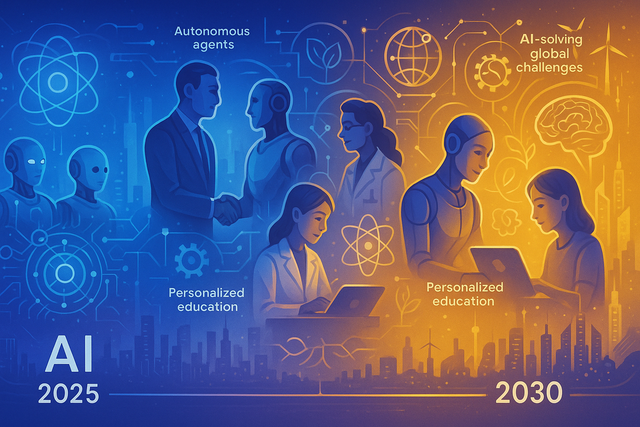
🚀 Looking Ahead: AI's Transformative Decade
As we stand at the end of 2025, with breakthrough achievements in GPT-5, quantum computing, and enterprise AI implementation, the trajectory suggests the next five years will be the most transformative in human technological history.
🏗️ The Current Foundation: What We've Built
Technical Foundations
Unified AI architectures, multimodal integration, quantum-AI convergence, comprehensive safety frameworks
Global Deployment
700M users accessing advanced AI, proven enterprise ROI, 280x cost reduction democratizing access
Infrastructure
Specialized AI chips, quantum processors, global cloud infrastructure enabling new capabilities
📅 2026-2027: The Acceleration Phase
🤖 Autonomous Agent Maturation
Multi-Step Planning
Agents planning and executing complex multi-day projects autonomously
Collaborative Networks
Multiple AI agents working together on complex problems
Learning & Adaptation
Agents improving performance through experience and feedback
🏥 Healthcare AI Revolution
🌟 2028-2030: The Transformation Phase
💼 Workforce Transformation
Creative Collaboration
AI as creative partners in artistic and intellectual work
Enhanced Productivity
AI amplifying human capabilities rather than replacing them
Skill Evolution
Focus on uniquely human skills: creativity, empathy, strategic thinking
🎓 Education Revolution
🔬 Key Technological Breakthroughs Expected
AGI Milestones
General problem solving, transfer learning, common sense reasoning, self-improvement capabilities
Quantum-Classical Hybrids
Optimization breakthroughs, cryptography revolution, complex system simulation, ML acceleration
Brain-Computer Interfaces
Cognitive enhancement, seamless communication, learning acceleration, therapeutic applications
🌍 Societal Implications and Challenges
• Economic: Potential 2-3x productivity increase, new industries, wealth distribution challenges
• Social: Evolving definitions of intelligence and creativity, new collaboration forms
• Governance: AI rights questions, human agency preservation, privacy-capability balance
🎯 Preparations for the AI Future
Individual Preparation
AI literacy, creative skill development, adaptability mindset, ethical reasoning
Organizational Strategy
AI integration plans, human-AI collaboration design, continuous innovation, ethical frameworks
Societal Preparation
Education reform, social safety nets, governance innovation, global cooperation
⚠️ Risks and Mitigation Strategies
• Technical: Alignment problems, robustness across scenarios, interpretability, security from malicious use
• Social: Inequality concerns, workforce displacement management, avoiding over-dependence, preserving human agency
🏆 Conclusion: Shaping Our AI Future
The next five years represent a critical period in human history. The decisions we make today about AI development, governance, and integration will shape human civilization for decades to come.