The AI Agents Revolution: Autonomous Systems Transform Industries
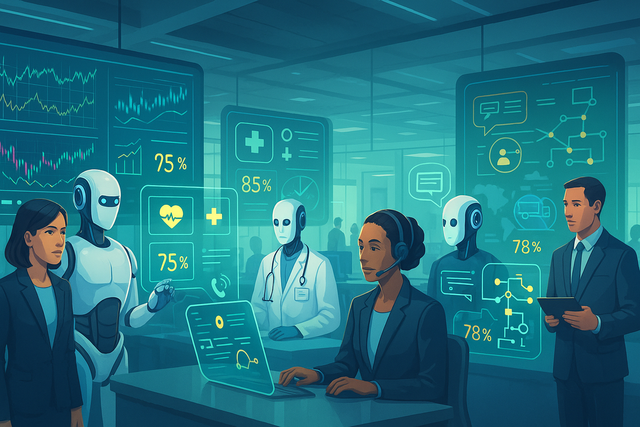
The year 2025 has marked a decisive shift in artificial intelligence from reactive tools to proactive autonomous agents. Organizations worldwide are deploying AI agents that can reason, make decisions, and execute complex multi-step workflows with minimal human intervention
🤖 The Rise of Autonomous AI Systems
AI agents represent a fundamental advancement from reactive systems to proactive autonomous intelligence capable of complex multi-step reasoning and decision-making.
🎯 Defining AI Agents: Beyond Simple Chatbots
Unlike traditional AI systems that respond to specific queries, AI agents represent a fundamental advancement in autonomous intelligence. These systems possess the capability to:
📋 Planning
Execute complex multi-step operations with strategic foresight
🧠 Reasoning
Navigate through ambiguous situations with contextual understanding
⚡ Decision-Making
Make informed choices based on comprehensive contextual information
🔄 Action Execution
Take coordinated actions across multiple systems and platforms
📚 Learning
Adapt and improve from outcomes and experiences
This evolution from reactive to proactive AI marks a paradigm shift that could fundamentally alter how we approach automation and decision-making in enterprise environments81 .
💼 Enterprise Implementation: Real-World Success Stories
Salesforce's Agentforce platform exemplifies the practical application of AI agents in enterprise settings. By integrating Claude models into Einstein 1 Studio, Salesforce has created agents capable of orchestrating complete business workflows
These agents don't just provide responses—they actively:
- Analyze customer data comprehensively across touchpoints
- Execute transactions autonomously with safety checks
- Update records across integrated systems
- Coordinate complex processes end-to-end
💡 The integration leverages Salesforce's Einstein Trust Layer, ensuring that autonomous actions maintain security and compliance standards throughout execution38 .
🏗️ Infrastructure Investment: The Foundation for Scale
The development of enterprise-grade AI agents requires massive computational resources:
Anthropic's multibillion-dollar deal with Google to access up to 1 million Tensor Processing Units (TPUs) demonstrates the scale of infrastructure investment required
Similarly, the expansion of Google Cloud TPU services for training and serving Claude models indicates the industry-wide recognition that autonomous AI systems need robust, scalable infrastructure to function reliably
🛠️ Framework and Development Tools
The AI agent ecosystem has matured significantly, with developers now having access to sophisticated frameworks and tools:
🔧 Specialized Frameworks
Tools designed specifically for building and deploying autonomous AI systems
🎨 Multi-Modal Capabilities
Process text, images, audio, and video inputs simultaneously
🔌 Tool Integration APIs
Standardized interfaces for agents to interact with external systems
🛡️ Safety & Governance
Built-in mechanisms for ensuring responsible autonomous behavior
🏭 Industry-Specific Applications
💰 Financial Services
In the financial sector, agents are handling complex risk analysis, fraud detection, and customer service workflows. The ability to process vast amounts of data in real-time while maintaining regulatory compliance makes AI agents particularly valuable in this highly regulated industry
- Risk Analysis: Real-time market monitoring and exposure assessment
- Fraud Detection: Pattern recognition across millions of transactions
- Compliance: Automated regulatory requirement verification
🏥 Healthcare
Healthcare organizations are leveraging AI agents for patient care coordination, medical documentation, and diagnostic support. The agents can integrate with electronic health records, schedule appointments, and provide preliminary health assessments while maintaining strict privacy and security standards
📞 Customer Service
AI agents are revolutionizing customer service by providing 24/7 support that goes beyond simple question-answering. These agents can resolve complex issues, process returns, and escalate problems to human agents when necessary—all while maintaining a consistent, helpful tone
🏛️ Technical Architecture: How AI Agents Work
Modern AI agents typically employ a sophisticated multi-layered architecture:
1️⃣ Perception Layer
Processes and understands input from various sources including text, audio, and visual data
2️⃣ Cognition Layer
Plans and reasons about actions to take using advanced reasoning models
3️⃣ Action Layer
Executes planned actions through APIs and integrations with external systems
4️⃣ Memory Layer
Maintains context and learns from previous interactions for continuous improvement
5️⃣ Safety Layer
Ensures actions remain within acceptable boundaries and compliance frameworks
This five-layer architecture enables AI agents to perceive, think, act, remember, and self-regulate—mirroring human cognitive processes.
⚠️ Challenges and Considerations
Despite their potential, AI agents face several significant challenges:
🎯 Reliability
Ensuring agents make correct decisions in complex, ambiguous situations
🛡️ Safety
Preventing harmful actions, especially in high-stakes environments
🔍 Transparency
Making agent decision-making processes understandable to humans
📋 Compliance
Meeting industry-specific requirements for data handling and decision-making
⚖️ Regulatory Landscape
Governments worldwide are developing frameworks to govern AI agent deployment. The US federal agencies increased AI-related regulations by 59 actions in 2024, while global legislative mentions of AI increased by 21.3% since 2023
California's landmark SB 53, signed in September 2025, establishes transparency requirements for frontier AI systems, potentially setting a precedent for other jurisdictions70 .
👥 The Future of Work with AI Agents
As AI agents become more capable and widespread, they will fundamentally change the nature of work. Rather than replacing humans, these agents are likely to augment human capabilities, allowing workers to focus on higher-level strategic tasks while agents handle routine operations.
The Stanford AI Index 2025 suggests that organizations using AI see measurable productivity improvements, and this trend is likely to accelerate as autonomous agents become more sophisticated
🔮 Looking Ahead: The Next Phase of AI Agent Development
The next 12-18 months will be crucial for AI agent adoption. Key developments to watch include:
🧠 Enhanced Reasoning
Improved reasoning capabilities for more complex decision-making scenarios
🔗 Better Integration
Seamless integration with existing enterprise systems and workflows
🛡️ Safety Measures
Enhanced safety and reliability measures for mission-critical applications
🤝 Multi-Agent Collaboration
More sophisticated multi-agent systems working together on complex tasks
🎯 Industry Templates
Industry-specific agent templates and frameworks for rapid deployment
As these systems mature, we can expect to see AI agents handling increasingly complex, multi-faceted business processes, ultimately transforming how organizations operate and compete in the global marketplace.