The AI Model Competition: How Frontier Models Are Reshaping the Technology Landscape
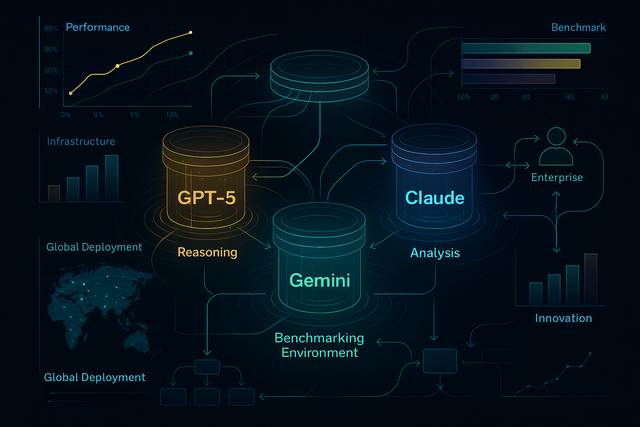
🏁 The Great AI Model Race of 2025
2025 has witnessed unprecedented competition in the AI model landscape, with major players vying for dominance across multiple dimensions of artificial intelligence capability. This competition is not merely about model size or benchmark performance—it's about practical utility, safety, cost-effectiveness, and ecosystem integration.
🎯 The Current Model Landscape
The frontier AI model competition is dominated by three major players, each with distinct strengths:
OpenAI GPT-5
Unified architecture, 45% hallucination reduction, multimodal excellence, 5,000 hours safety testing
Anthropic Claude
Enterprise focus, Constitutional AI, 44% faster cybersecurity, proven ROI in regulated industries
Google Gemini
Quantum computing leadership, ecosystem integration, 13,000x speedup, cancer research breakthroughs
📊 Performance Competition: Beyond Benchmarks
💻 Infrastructure and Scale Competition
• Anthropic-Google: $47.5B deal for 1M TPUs
• OpenAI-AWS: Multi-year global infrastructure partnership
• Google Internal: Proprietary AI chips and data centers
• Global Scale: 700M ChatGPT users, extensive Google ecosystem integration
🛡️ Safety and Alignment Competition
GPT-5 Safety
5,000 hours red-teaming, 2.1% deception rate (down from 4.8%), enhanced dual-use safety protocols
Claude Constitutional AI
Predictable behavior training, enterprise-grade interpretability, proven regulated industry performance
Google Safety Framework
Secure AI Framework 2.0, comprehensive testing protocols, industry collaboration on safety standards
🎯 Market Positioning Strategies
OpenAI: Democratization
Free tier access, developer-friendly APIs, educational initiatives, global cloud partnerships
Anthropic: Enterprise
Industry-specific solutions, compliance emphasis, proven ROI, long-term alignment focus
Google: Ecosystem
Service integration, cloud optimization, consumer products, research-to-product pipeline
🔮 Future Trends
• Specialization: Code models, scientific models, multimodal and edge models emerging
• Open Source Pressure: Meta Llama, Chinese Qwen models creating competitive pressure
• Geographic Competition: US (40 models), China (15 models), Europe (3 models) leading regional innovation
• Evaluation Evolution: Moving from static benchmarks to continuous, real-world performance monitoring
🏆 Conclusion: Competition Driving Innovation
The intense competition between AI model providers in 2025 is driving unprecedented innovation. Success requires not just benchmark performance, but practical value delivery, safety assurance, and seamless ecosystem integration.