Stanford AI Index 2025: The Most Comprehensive Analysis of AI Progress
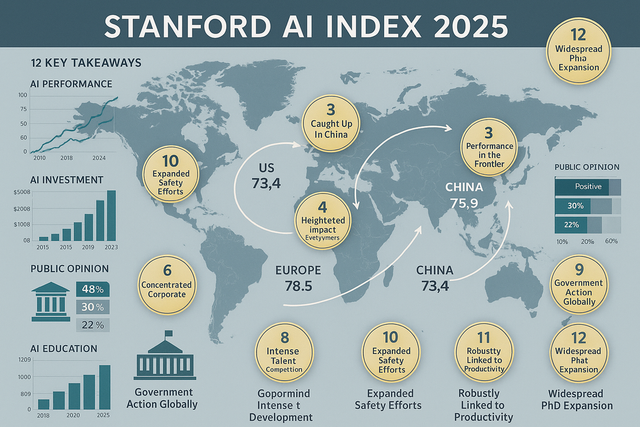
📊 The Stanford Human-Centered AI Institute's 2025 AI Index Report represents the most comprehensive, data-driven analysis of artificial intelligence development available. This extensive report provides crucial insights into AI's technical progress, economic influence, and societal impact, serving as an essential reference for policymakers, business leaders, and researchers worldwide.
📖 The Definitive AI Report of 2025
The Stanford Human-Centered AI Institute's 2025 AI Index Report represents the most comprehensive, data-driven analysis of artificial intelligence development available. This extensive report provides crucial insights into AI's technical progress, economic influence, and societal impact, serving as an essential reference for policymakers, business leaders, and researchers worldwide
🎯 12 Key Takeaways: A Comprehensive Overview
🌟 Essential Insights: The 2025 AI Index reveals twelve critical insights that define the current state of AI across technical, economic, and societal dimensions.
The 2025 AI Index reveals twelve critical insights that define the current state of AI:
1️⃣ Performance on Demanding Benchmarks Continues Improving
✅ Dramatic Progress: AI systems have achieved remarkable performance improvements on challenging benchmarks, with increases ranging from 18.8 to 67.3 percentage points!
AI systems have achieved remarkable performance improvements on challenging benchmarks introduced in 2023:
- 📊 MMMU: 18.8 percentage point increase from 2023 to 2024
- 🎓 GPQA: 48.9 percentage point increase, demonstrating dramatic improvement in graduate-level reasoning
- 💻 SWE-bench: 67.3 percentage point increase in software engineering capabilities
These improvements indicate that AI systems are rapidly approaching human-level performance on complex intellectual tasks.
2️⃣ AI Increasingly Embedded in Everyday Life
🏥 Medical Devices
FDA approved 223 AI-enabled medical devices in 2023 (compared to just 6 in 2015)
🚗 Transportation
Waymo provides over 150,000 autonomous rides weekly
🌍 International Deployment
Baidu's Apollo Go robotaxi fleet serves numerous Chinese cities
AI has transitioned from laboratory research to widespread practical application. This embeddedness indicates AI is becoming a fundamental technology infrastructure rather than a specialized tool.
3️⃣ Business Investment Reaches Record Levels
The private AI investment landscape shows unprecedented growth—this represents a massive shift in how businesses view and implement AI technology.
4️⃣ US-China Competition in AI Model Development
ℹ️ Global Competition: The US leads in quantity with 40 notable models, while China rapidly improves quality with 15 models—creating a dynamic competitive environment.
The global AI development landscape shows clear regional patterns:
- 🇺🇸 US Leadership: 40 notable AI models produced by US-based institutions in 2024
- 🇨🇳 China's Progress: 15 notable models, rapidly closing the quality gap
- 🌍 Global Distribution: Model development increasingly international
This indicates that while the US leads in quantity, China is rapidly improving in quality, creating a dynamic competitive environment.
5️⃣ Responsible AI Ecosystem Evolution
⚠️ Growing Concerns: AI-related incidents are increasing in frequency and complexity, while standardized Responsible AI evaluations remain rare among major developers.
The responsible AI landscape is developing but facing challenges:
📈 Incidents Rising
AI-related incidents increasing in frequency and complexity
🔍 Evaluation Gap
Standardized Responsible AI evaluations rare among developers
🛡️ New Benchmarks
Tools like HELM Safety, AIR-Bench, and FACTS emerging
🏛️ Government Action
Global cooperation on AI governance showing increased urgency
6️⃣ Global AI Optimism with Regional Variations
High Optimism Regions
China (83%), Indonesia (80%), Thailand (77%)
Skeptical Regions
Canada (40%), US (39%), Netherlands (36%)
Positive Trend
Sentiment shifting positively in previously skeptical countries since 2022
These variations suggest cultural and policy factors significantly influence public AI perception.
7️⃣ AI Becomes More Efficient, Affordable, and Accessible
✅ Cost Revolution: GPT-3.5 inference costs dropped over 280-fold from November 2022 to October 2024—democratizing AI access across organizations of all sizes!
Cost and accessibility improvements are dramatic:
- 💰 Inference Cost Reduction: GPT-3.5 costs dropped over 280-fold from November 2022 to October 2024
- 💻 Hardware Efficiency: 30% annual cost decline, 40% annual energy efficiency improvement
- 🔓 Open Source Progress: Performance gap from closed models reduced from 8% to 1.7%
8️⃣ Governments Stepping Up with Regulation and Investment
Governmental action on AI is accelerating—this represents unprecedented governmental engagement with AI technology:
🇺🇸 United States
59 AI-related regulations in 2024
🇨🇦 Canada
$2.4B AI investment
🇨🇳 China
$47.5B semiconductor fund
🇫🇷 France
€109B commitment
🇮🇳 India
$1.25B investment
🇸🇦 Saudi Arabia
$100B Project Transcendence
9️⃣ AI and Computer Science Education Expansion
🎓 Education Revolution: Two-thirds of countries now offer or plan K-12 computer science education—doubled from 2019!
Educational infrastructure is rapidly expanding:
- 🌍 Global K-12 Coverage: Two-thirds of countries offer or plan K-12 computer science education (doubled from 2019)
- 🇺🇸 US Higher Education: 22% increase in bachelor's degrees in computing over the last 10 years
- 👨🏫 Teacher Preparedness: 81% of K-12 CS teachers believe AI should be foundational in curriculum
However, infrastructure gaps and teacher training remain significant challenges.
🔟 Industry Dominance in AI Development
ℹ️ Industry Shift: Nearly 90% of notable AI models in 2024 came from industry (up from 60% in 2023)—indicating a mature, competitive industry with rapid iteration cycles.
The AI development landscape is increasingly commercial:
🏢 Industry Leadership
Nearly 90% of notable AI models in 2024 came from industry (up from 60% in 2023)
📈 Scale Growth
Training compute doubles every 5 months, datasets every 8 months, power use annually
🎯 Competitive Frontier
Performance gaps between top models shrinking (0.7% between top two models)
1️⃣1️⃣ AI's Growing Scientific Impact
✅ Scientific Recognition: Two Nobel Prizes awarded for deep learning and protein folding research—indicating AI's maturation as a scientific discipline!
AI's importance in scientific research is being formally recognized:
- 🏆 Nobel Prizes: Two Nobel Prizes awarded for deep learning and protein folding research
- 🎖️ Turing Award: Reinforcement learning recognized as foundational contribution to computing
This formal recognition indicates AI's maturation as a scientific discipline.
1️⃣2️⃣ Complex Reasoning Remains a Challenge
⚠️ Key Limitation: Despite impressive advances, AI struggles with benchmarks like PlanBench and complex logic tasks—general reasoning capabilities remain an open challenge.
Despite impressive advances, fundamental limitations persist:
- ✅ Mathematical Tasks: AI models excel at International Mathematical Olympiad problems
- ⚠️ Complex Reasoning: Struggles with benchmarks like PlanBench and logic tasks
- 🎯 High-Stakes Limitations: Effectiveness limited in scenarios requiring complex, multi-step reasoning
This suggests that while AI has achieved superhuman performance in specific domains, general reasoning capabilities remain an open challenge.
🔬 Methodology and Data Sources
The Stanford AI Index employs rigorous methodology to ensure comprehensive and accurate analysis:
📊 Data Collection
Analyzes data from 2023-2024, with some trends extending back to 2015
🌍 Global Scope
Covers developments across multiple continents and economic regions
🔗 Multiple Sources
Integrates academic research, industry reports, government statistics, and proprietary databases
✅ Peer Review
Findings subject to review by leading AI researchers and industry experts
🎯 Implications for Different Stakeholders
🏛️ For Policymakers
ℹ️ Policy Insights: The report provides crucial insights for regulatory and investment decisions grounded in comprehensive data analysis.
- Evidence-based policy making grounded in comprehensive data analysis
- Understanding of global competitive dynamics and opportunities for leadership
- Recognition of the need for both innovation support and responsible governance
- Awareness of educational infrastructure requirements for future AI workforce
💼 For Business Leaders
Key strategic insights include:
- The accelerating pace of AI advancement requiring proactive adoption strategies
- The democratization of AI capabilities through cost reductions and open-source development
- The importance of responsible AI practices for competitive advantage
- The need for workforce development and AI literacy programs
🔬 For Researchers and Academics
Important research directions and opportunities:
- Focus areas for addressing current AI limitations, particularly in complex reasoning
- Opportunities for contributing to the responsible AI ecosystem
- Educational needs and curriculum development priorities
- Interdisciplinary collaboration opportunities across AI and other fields
🌍 Global Investment Analysis
🇺🇸 United States
$109.1B investment, 40 notable models, 59 regulations, 39% optimism
🇨🇳 China
$9.3B investment, 15 models, leads in publications/patents, 83% optimism, $47.5B semiconductor fund
🇫🇷 France
€109 billion commitment
🇨🇦 Canada
$2.4 billion pledge
🇮🇳 India
$1.25 billion investment
🇸🇦 Saudi Arabia
$100B Project Transcendence
📋 The Path Forward: Key Recommendations
✅ Strategic Directions: Based on comprehensive analysis, the report suggests critical paths for continued progress and addressing challenges.
🚀 For Continued Progress
- Maintain investment in fundamental AI research while supporting practical applications
- Develop robust responsible AI frameworks and evaluation methodologies
- Expand educational infrastructure to prepare the workforce for an AI-driven economy
- Foster international cooperation on AI governance and standards
⚠️ For Addressing Challenges
- Prioritize research on complex reasoning and general intelligence capabilities
- Develop better tools for AI system evaluation and monitoring
- Address the gap between AI capabilities and responsible deployment practices
- Ensure equitable access to AI benefits across different populations and regions
🔮 Looking Ahead: The Next AI Index
The 2025 AI Index sets the foundation for understanding AI's trajectory. Future reports will likely focus on:
- Progress in addressing the complex reasoning challenges identified
- Evolution of the competitive landscape as new players emerge
- Development of more sophisticated responsible AI frameworks
- Impact of AI on global economic and social structures
🎯 Conclusion: A Comprehensive Vision of AI's Present and Future
🌟 Essential Reading: The Stanford AI Index 2025 provides the most complete picture of artificial intelligence's current state and trajectory available—essential for anyone seeking to understand AI's implications for the future.
The Stanford AI Index 2025 provides the most complete picture of artificial intelligence's current state and trajectory available. Its comprehensive analysis reveals an AI field that is rapidly maturing, becoming more accessible, and increasingly integrated into global economic and social systems.
While impressive advances in performance and accessibility are evident, the report also highlights significant challenges that require attention—especially in the areas of complex reasoning, responsible deployment, and equitable access. The data suggests that AI is at a critical juncture where the choices made by policymakers, researchers, and industry leaders will significantly influence its future development and impact.
For anyone seeking to understand the current state of AI and its implications for the future, the Stanford AI Index 2025 provides essential insights backed by rigorous analysis and comprehensive global data. It serves as both a celebration of AI's achievements and a roadmap for addressing the challenges that lie ahead.