AI Coding Agents and Developer Velocity: From Inline Autocomplete to Autonomous Systems
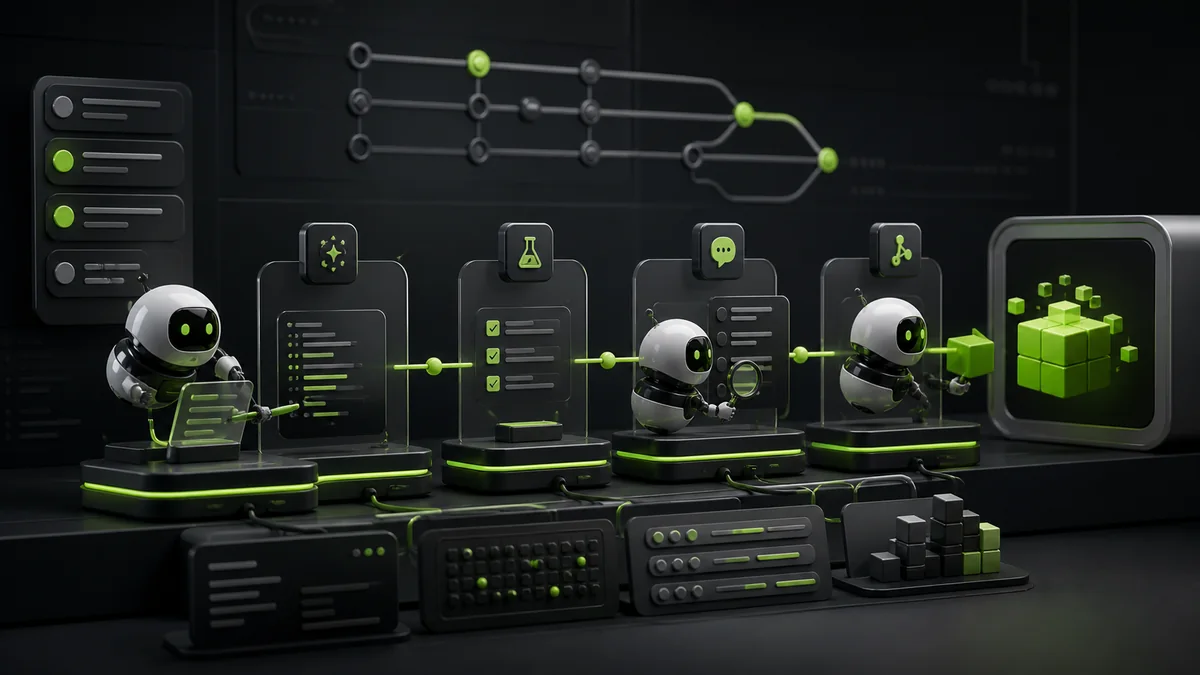
Software engineering has experienced three distinct AI eras: the Autocomplete Era (2021–2023), the Chat Sidebar Era (2023–2025), and the Autonomous Coding Agent Era (2026). Teams that master agentic workflows are shipping complex products five times faster than traditional developers.
However, velocity without discipline produces fragile software. In this guide, we break down how professional software houses structure agentic development workflows, prevent code slop, and use AI to enforce rigorous code quality.
The Evolution of AI Coding Tools
Understanding the capability leap between generations clarifies how modern software is built:
| Generation | Interaction Paradigm | Context Awareness | Autonomous Action |
|---|---|---|---|
| Gen 1 (2021) | Inline ghost text autocomplete | Current file only (~20 lines) | None |
| Gen 2 (2023) | Chat sidebar in IDE | Selected snippets, open tabs | Manual copy-paste |
| Gen 3 (2026) | Autonomous Agent (Terminal / IDE) | Entire repository + git history + docs | Runs tests, reads errors, edits multiple files, commits PRs |
The 4 Pillars of Disciplined Agentic Development
At Infusible Coder, our developers adhere to four core principles when working alongside AI agents:
1. Specification-First Architecture
Never instruct an agent to "build a checkout system". Vague prompts yield hallucinated assumptions. Instead, draft a concise behavior specification: define exact API request payloads, HTTP response statuses, authentication tokens, idempotency rules, and failure edge cases. When the specification is clear, the generated implementation is virtually flawless.
2. Test-First Verification Loops
The greatest strength of an autonomous agent is its ability to test itself. When implementing a new feature, have the agent write unit and integration tests first. The agent then runs the test suite, watches tests fail (Red), writes the minimal clean code to pass (Green), and refactors.
3. Project Memory and Rules Configuration
Modern agentic tools read configuration files (such as AGENTS.md or project customization rules) placed at the root of the codebase. By codifying naming conventions, state management patterns, and architectural rules in plain markdown, the AI strictly mirrors your team's established engineering practices.
4. The Zero Cognitive Debt Principle
If an engineer cannot explain every line of code committed to a repository, that code is technical debt waiting to explode. We enforce human comprehension checkpoints: review every diff, run static analysis, and verify edge-case coverage before merging.
Sample Machine-Readable Project Rule (AGENTS.md)
# Project Engineering Guidelines for AI Agents

## Architectural Rules
- All database queries must use parameterized prepared statements.
- React components must be modular and adhere to the predefined design tokens in index.css.
- Never introduce new external npm packages without explicit architectural justification.
- Every API endpoint must have an accompanying automated integration test.
The High-Leverage Software Team of the Future
The developers who command the highest value are no longer the fastest typists. They are the systems thinkers who can write crystal-clear specifications, design resilient architectures, and orchestrate fleets of AI agents to implement, verify, and deploy production systems.
Want to level up your engineering skills or build software with an elite modern team? Explore our Full Stack Web Development course or partner with our software engineering team.
Frequently asked questions
What is the difference between an AI Copilot and an AI Coding Agent?
An AI Copilot provides inline text completions and answers chat questions based on small local context windows. An AI Coding Agent autonomously searches codebases, plans multi-file refactors, executes terminal commands, runs unit tests, inspects failures, and iterates until tests pass.
Does AI-generated code accumulate cognitive debt?
Yes. If developers blindly accept AI-generated code without understanding its internal workings, the team accumulates 'cognitive debt'—shipping code faster than it can be audited and maintained. Strong engineering teams enforce strict review gates and automated verification.
What is Specification-Driven Development with AI?
Specification-Driven Development means writing clear, machine-readable specifications (defining inputs, outputs, edge cases, and constraints) before generating code. The agent writes tests to that specification, guaranteeing deterministic behavior.
Will AI coding agents replace software engineers?
No. They eliminate repetitive boilerplate typing and manual syntax wrangling, shifting the engineer's role toward system architecture, domain modeling, verification, security auditing, and high-level product design.
Put this AI approach to work
Infusible Coder designs production AI and software systems for businesses, and teaches practical AI skills through our training programs in Kohat and online.