Course Roadmaps
DevOps and Cloud Course Roadmap 2026: Linux, Docker, CI/CD and AWS
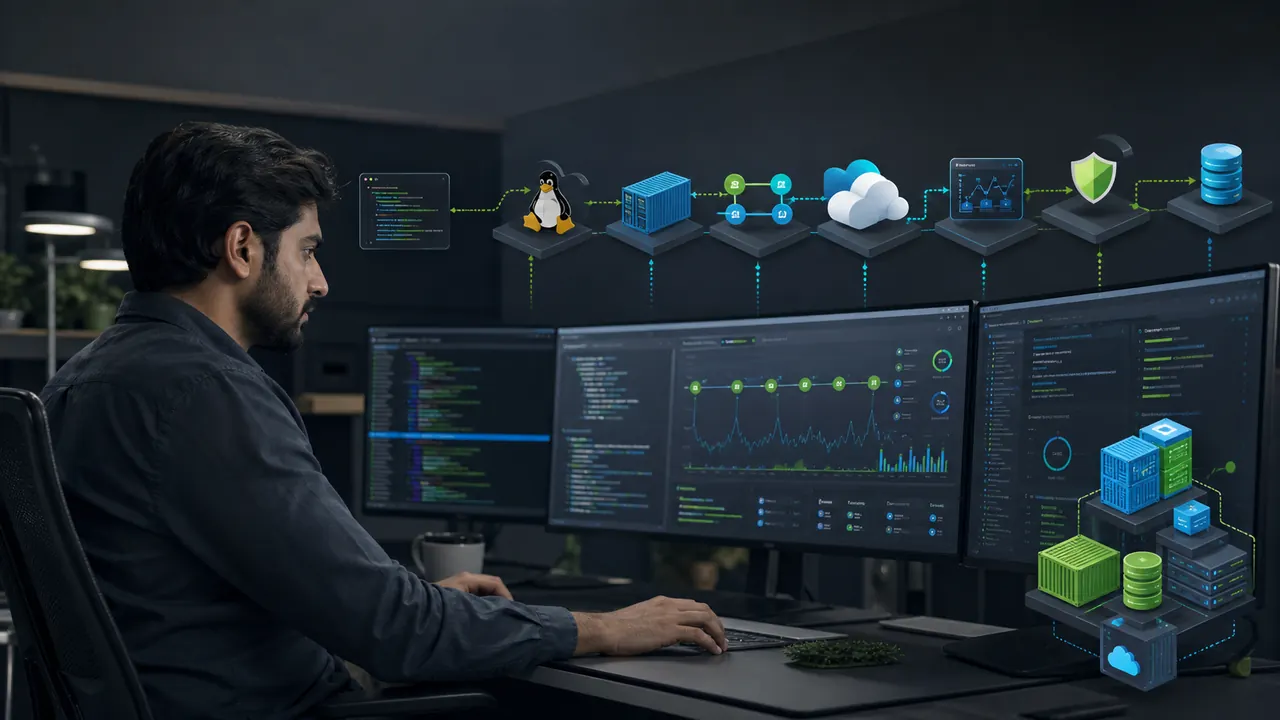
DevOps connects software development with the systems and feedback needed to deliver changes safely. Learning a few Docker commands is useful, but it is not the whole discipline. A practical course should move from operating-system and network foundations to repeatable builds, automated checks, controlled deployment, monitoring, and recovery.
This roadmap helps learners compare the DevOps and Cloud course with general programming courses.
Start with Linux, networks, and version control
Practise files, permissions, processes, services, packages, environment variables, logs, SSH, and shell commands. Learn DNS, IP addresses, ports, HTTP, TLS, and reverse proxies well enough to trace a request. Use Git branches, reviews, tags, and releases so infrastructure changes have the same history as application code.
Understand containers beyond commands
Docker’s official learning path introduces containers, images, registries, Dockerfiles, image layers, ports, storage, Compose, caching, and multi-stage builds. Build an application image, run it with configuration, connect it to a database, and explain what persists after the container stops. Reduce image size and avoid putting secrets into layers.
Automate a delivery workflow
A GitHub Actions workflow is a configurable automated process with triggering events, jobs, runners, and steps. Create a pipeline that installs dependencies, runs lint and tests, builds an artifact, and deploys only after checks pass. Learn caching, environments, approvals, reusable workflows, protected branches, and least-privilege credentials.
Learn cloud concepts before memorizing services
Understand regions, availability, compute, storage, databases, networking, identity, pricing, shared responsibility, and backups. AWS’s foundation learning plan covers core services, pricing, and security, but the same concepts help on other providers. Draw the architecture and data flow before creating resources.
Add observability and recovery
Collect useful logs, metrics, traces, and health checks. Define what healthy means and which alerts require action. Simulate a failed deployment, expired secret, full disk, unavailable database, and slow dependency. Document rollback and restore steps instead of assuming uptime.
Treat security and cost as operating requirements
Apply least-privilege identities, rotate credentials, scan dependencies and images, patch base systems, and keep production access auditable. Separate public configuration from secrets. Learn how compute time, storage, outbound traffic, logs, managed databases, and idle resources affect a cloud bill, then add budgets and ownership tags before a training project grows.
Infrastructure as code should be introduced after you understand the resources it creates. Review a planned change, apply it in a test environment, and know how state and drift are handled. Automation should make a safe process repeatable; it cannot make an unclear process safe by itself.
Build one end-to-end delivery project
- Containerize a small web application and its dependencies.
- Run automated lint, tests, and builds on pull requests.
- Deploy through separate test and production environments.
- Use managed secrets and restricted identities.
- Add monitoring, a backup check, and a rollback runbook.
That project shows how parts fit together. Compare it with the full-stack course if you still need application foundations, or ask admissions which prerequisites apply to the current batch.
Sources and evidence
These first-party links are provided so you can review the referenced public activity at its original source.
Frequently asked questions
Can a beginner start a DevOps course?
A beginner can start cloud foundations, but practical DevOps becomes easier after basic Linux, networking, Git, and application-development knowledge. Confirm the course prerequisites.
Is Docker the same as DevOps?
No. Docker is a container platform used in many delivery workflows. DevOps also involves collaboration, version control, automated testing, CI/CD, infrastructure, security, monitoring, incident learning, and operational ownership.
What should a DevOps portfolio project demonstrate?
Show a versioned application, container image, automated test and deployment workflow, environment configuration, secure secret handling, health checks, logs, rollback notes, and clear documentation.