GraphRAG vs Vector RAG: Which Architecture Does Your Enterprise Knowledge Base Need?
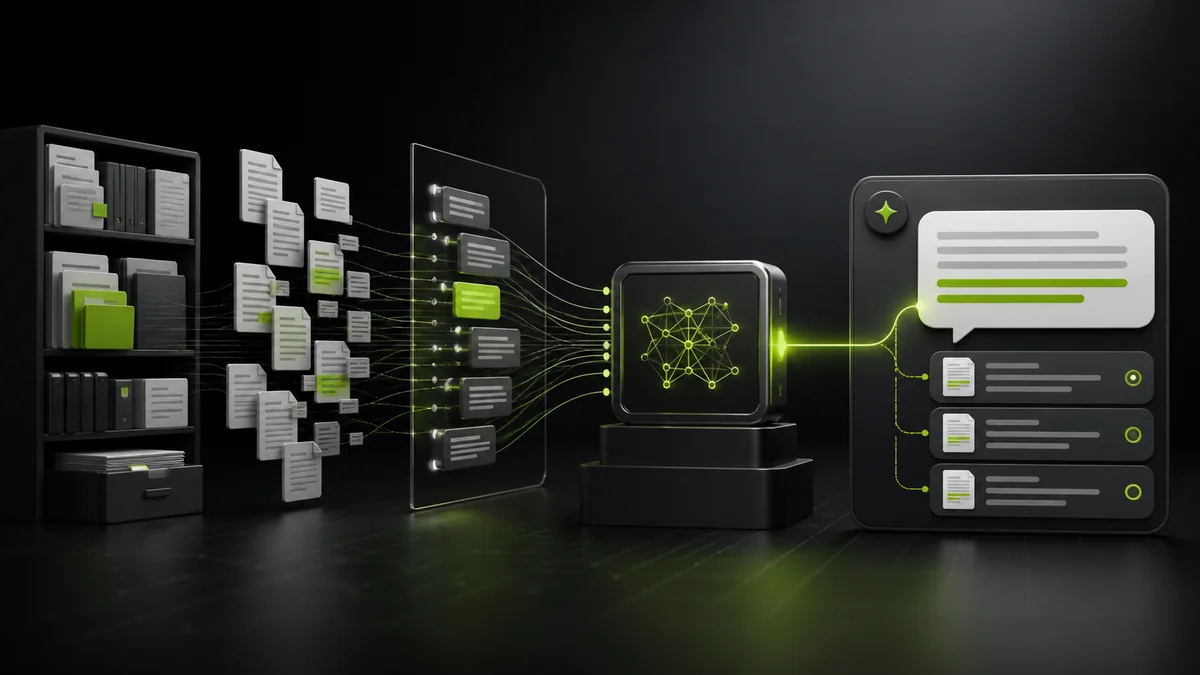
Retrieval-Augmented Generation (RAG) is the foundational architecture of enterprise AI. Yet, traditional chunk-and-embed vector search has a severe blind spot: it cannot answer holistic, aggregated questions across large document corpuses. GraphRAG (Knowledge Graph RAG) resolves this limitation.
If you have ever deployed a document assistant that gave superb answers to specific questions but completely stumbled when asked to summarize overarching trends across an entire folder, you have experienced the vector boundary. Let us dive into why this happens and how GraphRAG fixes it.
Where Vector RAG Fails: The Semantic Similarity Trap
Traditional Vector RAG operates on a simple premise:
- Split documents into 500-word text chunks.
- Generate dense vector embeddings for each chunk using an embedding model.
- Store vectors in a vector database (e.g. Pinecone, Qdrant, Milvus, pgvector).
- At query time, embed the user query and retrieve the top-K closest chunks by cosine similarity.
This works brilliantly for local, pinpoint search: "What is the return policy for defective laptops under warranty?"
However, it fails completely on global, multi-hop queries: "What are the top 5 operational bottlenecks mentioned across all monthly department reports from Q1 to Q4?" Because the answer is not contained within any single chunk, vector similarity fails to retrieve the necessary pieces, causing the LLM to hallucinate or reply that it cannot find the information.
How GraphRAG Works: Entities, Relationships & Communities
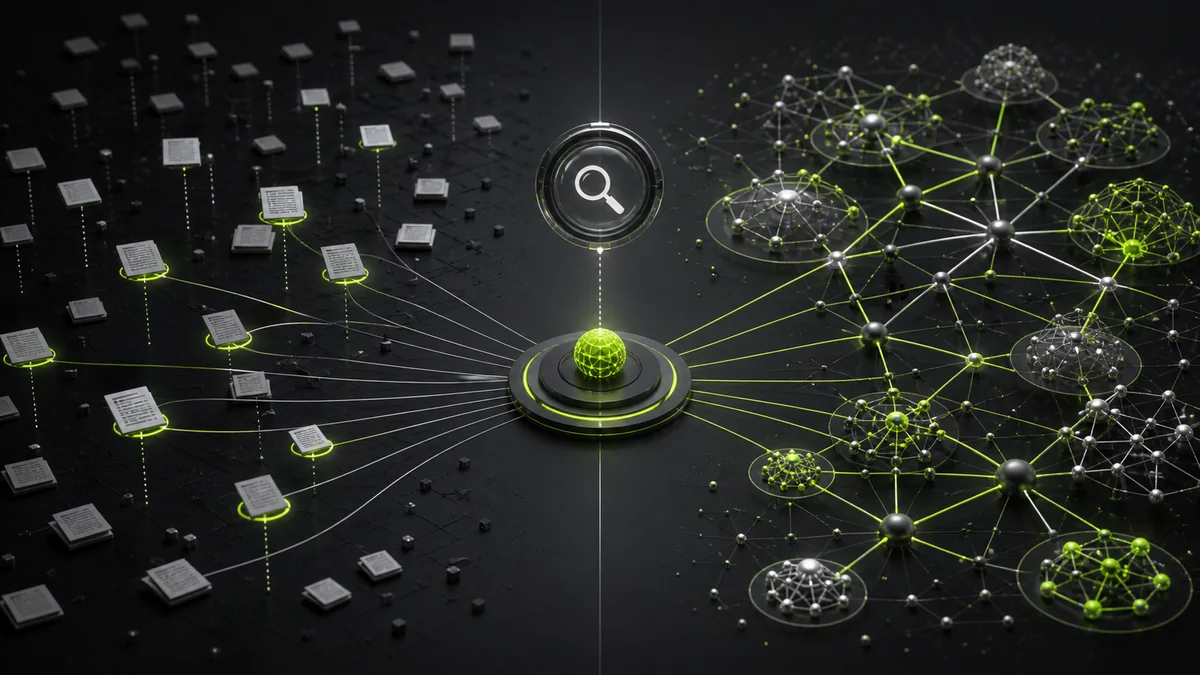
GraphRAG transforms unstructured documents into a structured, hierarchical Knowledge Graph through four distinct stages:
1. Entity and Relationship Extraction
During indexing, an LLM processes text chunks and identifies domain entities (People, Organizations, Technologies, Locations, Concepts) along with directed relationships (e.g. [Engineer A] --(developed)--> [Module B]).
2. Graph Construction and Entity Resolution
Identified entities are normalized and linked into a graph structure where nodes represent concepts and edges represent verified connections.
3. Leiden Community Detection
The graph is segmented into modular clusters ("communities") using the Leiden algorithm. Closely related entities form tightly knit groups at multiple hierarchical levels (from fine-grained sub-teams to high-level organizational divisions).
4. Hierarchical Community Summarization
An LLM generates pre-computed summaries for each community cluster. When a user asks a broad global question, GraphRAG queries these pre-synthesized community summaries rather than searching through thousands of raw document chunks.
Architecture Comparison Matrix
| Dimension | Traditional Vector RAG | GraphRAG (Knowledge Graph) |
|---|---|---|
| Best For | Pinpoint facts, direct lookups, FAQs | Holistic summaries, multi-hop queries, relationship discovery |
| Indexing Cost | Very Low (fast embedding generation) | Higher (LLM entity extraction & clustering) |
| Multi-Hop Reasoning | Weak (misses cross-document links) | Exceptional (traverses graph edges natively) |
| Update Complexity | Simple (insert/delete vectors) | Requires graph edge updates & community re-clustering |
| Storage Backend | pgvector, Chroma, Qdrant, Pinecone | Neo4j, Memgraph, NetworkX + Vector store |
Building a Hybrid RAG Architecture
In production applications built by Infusible Coder, we implement a Dual-Routing Hybrid Pipeline:
# Conceptual Hybrid Query Router
async def hybrid_query_router(user_query: str):
    # Classify query intent using a fast SLM classifier
    intent = classify_query_type(user_query) # 'specific_fact' vs 'thematic_summary'

    if intent == "specific_fact":
        # Route to high-speed Vector search
        chunks = vector_store.similarity_search(user_query, top_k=5)
        return generate_grounded_answer(user_query, chunks)

    elif intent == "thematic_summary":
        # Route to GraphRAG community summaries
        community_summaries = graph_store.get_relevant_communities(user_query)
        return generate_global_synthesis(user_query, community_summaries)

    else:
        # Combined Hybrid Search: BM25 + Vector + Graph Expansion
        fused_context = hybrid_retriever.retrieve(user_query)
        return generate_grounded_answer(user_query, fused_context)
Budgeting for Enterprise Knowledge Bases
If your document corpus is under 5,000 pages and questions are primarily direct lookups, traditional Vector RAG with keyword fusion (BM25 + Dense Vectors) remains the most cost-effective solution. If your corpus involves legal contracts, medical research, or cross-department intelligence where understanding connections between entities is paramount, GraphRAG pays for itself within weeks.
Want to turn your enterprise files into a queryable knowledge engine? Learn more about our AI and data science engineering services or discuss a custom architecture on our contact page.
Frequently asked questions
What is the key difference between Vector RAG and GraphRAG?
Vector RAG chunks documents and indexes text embeddings for semantic similarity search. GraphRAG extracts entities and relationships into an interconnected Knowledge Graph and clusters them into community summaries, allowing the system to answer broad, holistic, and multi-hop relationship questions.
Why does standard Vector RAG fail on global questions?
Vector search only retrieves the top-K chunks most similar to the query words. If you ask 'What are the major recurring compliance risks across all departments?', no single chunk contains the complete answer, so vector search misses the overall synthesis.
Is GraphRAG more expensive to index than Vector RAG?
Yes. GraphRAG requires calling an LLM during the indexing pipeline to extract entities, build relationships, and generate community summaries. However, querying GraphRAG community summaries is often faster and uses fewer tokens than trying to retrieve dozens of text chunks.
Can I combine Vector RAG and GraphRAG together?
Yes. Hybrid RAG is the recommended production architecture: use vector search for specific pinpoint facts and GraphRAG community traversals for thematic, aggregated, and multi-hop questions.
Put this AI approach to work
Infusible Coder designs production AI and software systems for businesses, and teaches practical AI skills through our training programs in Kohat and online.